Joe Schmidt does not need another reminder that encouragement is not currency at Test level. The Wallabies produced enough against Ireland to suggest the project has bite, then lost 33-31 because the last quarter exposed the parts of their game that still lack cold certainty.
That is why France at Suncorp Stadium now feels less like a second-round fixture and more like a measuring strip. Australia’s attack can hurt elite opposition, but Schmidt’s side must prove it can protect a lead, manage the scoreboard and survive the physical squeeze France are preparing to bring to Brisbane.
France’s pack gives Brisbane a different edge
The French picture has changed since the opening loss to New Zealand. Rugby.com.au reported that Romain Ntamack, Peato Mauvaka, Emmanuel Meafou, Alexandre Roumat and Kalvin Gourgues were among the Toulouse players added to Fabien Galthie’s squad after the Top 14 final. Antoine Dupont has since withdrawn, with Paul Graou replacing him, but Meafou’s presence still changes the forward equation.
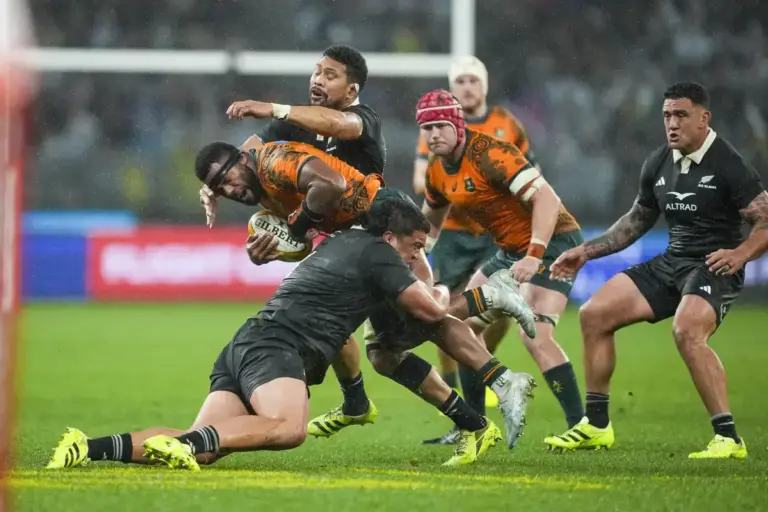
For Australia, that matters because the Ireland defeat was not just about missed kicks. The Wallabies had periods of genuine acceleration through Joseph-Aukuso Suaalii, Max Jorgensen and Jock Campbell, yet they could not keep Ireland out of the 22 when the pressure became repetitive. Thomas Clarkson’s late try was the obvious wound, but the deeper issue was control: penalties, exits, and the ability to make the opponent restart from distance rather than from attacking lineout territory.
Schmidt’s squad was built for this three-week window. The Wallabies confirmed a 37-man group before Tests against Ireland, France and Italy, with 20 forwards and 17 backs. That split looks sensible now, because France can turn Brisbane into a collision-heavy audit of Australia’s second-row depth, maul defence and bench impact.
The kicking debate is really a game-management debate
Tim Horan’s Ryan Lonergan point landed because it went beyond one missed shot. AAP’s Rugby.com.au report noted Australia conceded 12 penalties against Ireland, while Carter Gordon missed two conversions and Ben Donaldson missed two late long-range penalties. Horan’s argument was simple enough: at this level, Australia need multiple kicking solutions on the field late, not a last-minute scramble.
The selection question is complicated by the fitness picture. Lonergan impressed before leaving the Ireland match for a throat assessment, while Gordon was affected by calf cramp and awaits clearance. If both are available, Schmidt has the chance to retain the tempo that troubled Ireland while tightening the safety net around goal-kicking and exit strategy.
Campbell’s own review was blunt. He said Australia had to nail the moments around line breaks, secure possession after making damage, and stop handing opponents short-field entries. That is the core of the France challenge: the Wallabies do not need to become cautious, but their ambition has to be backed by cleaner detail.
The other layer is psychological. Australia were not blown away in Sydney; they were beaten after doing enough rugby to win and not enough management to close. That is the kind of defeat that can become useful only if the correction is immediate.
Australia’s July squad already looked like a transition group. After Ireland, it looks like a stress test. France will bring size, timing and a sharper set-piece threat. Schmidt’s Wallabies must answer with discipline, two reliable kickers and enough scoreboard nerve to turn progress into a result.