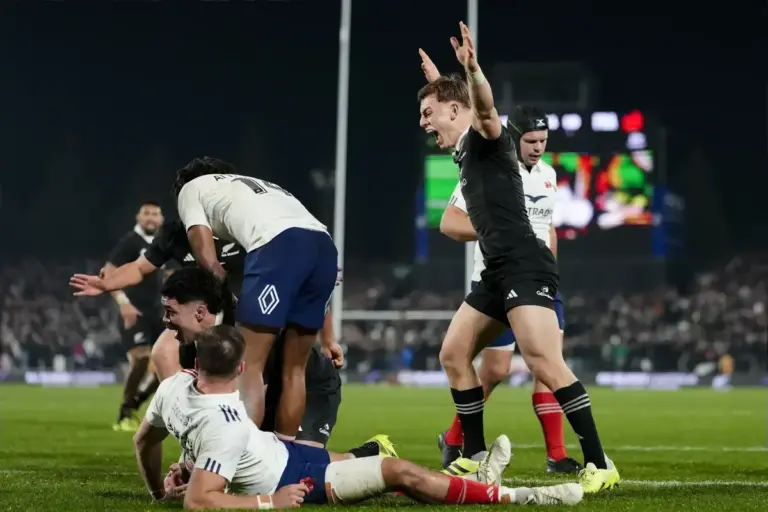
The All Blacks started the Rugby Nations Championship with a 34-32 win over France.
The Hurricanes pair Cam Roigard and Ruben Love were at the centre of attention for All Blacks fans as they impressed in attack to help the All Blacks beat the Six Nations champions in Christchurch.
Roigard produced a man of the match performance, while Love was making his first start for the All Blacks in the 10 jersey.
Full list of player ratings here.
A Hurricanes Blueprint on the International Stage
For years, the All Blacks’ tactical spine relied on the veteran wisdom of Richie Mo’unga and Beauden Barrett. But in Christchurch, Rennie unveiled a glimpse of the future—and it looks remarkably like Wellington. The decision to pair Cam Roigard and Ruben Love wasn’t just a selection based on form; it was an intentional tactical shift designed to inject raw unpredictability into New Zealand’s tactical framework.
Club combination matters immensely at the test match level. When a game fragments into chaotic transition play, players don’t have time to look up and read body language; they rely on instinct. Having spent countless minutes driving the Hurricanes’ high-octane Super Rugby attack, Roigard and Love brought an identical offensive shorthand to the international arena. They knew exactly when to play flat, when to utilise a deep looping runner, and, critically, how to manipulate the fringe defence before striking.
Against a massive French pack, this pre-existing chemistry kept the All Blacks’ attacking momentum alive even when the set-piece faltered. Instead of playing behind the gainline—the imaginary line across the pitch that teams try to cross to win territory—they stood their ground, playing with a courage that completely threw off Les Bleus’ defensive line speed.
Breaking Down the Tactics: How the Axis Unlocked Les Bleus
Roigard’s Man of the Match performance was a masterclass in modern scrum-half play. Traditionally, a number 9 is viewed as a dynamic distributor whose primary job is passing the ball to the fly-half. Roigard, however, plays like an extra loose forward. Standing at over 6 feet and weighing nearly 100kg, his willingness to challenge the defensive line creates immediate panic. Every time he threatened to snipe around the rucks, he drew two or three French defenders toward him, leaving fewer men to cover the wider channels.
This is where Ruben Love took control. Making your first international start at fly-half against France is one of the toughest challenges in World Rugby, but Love played with a maturity that belied his experience. Rather than dropping deep into a conservative kicking position, he stayed right on the advantage line, taking the ball flat to give the outside backs maximum room to exploit.
To help make sense of the high-level tactical language used by analysts, here is a breakdown of the key concepts that allowed the Roigard-Love pairing to dismantle the French defensive structures:
| Tactical Concept | What It Actually Means | Why It Mattered in Christchurch |
| Flat Attacking Alignment | Positioning receivers very close to the opposition defence rather than deep. | Left the French defenders with less than a second to react, neutralizing their aggressive rush defense. |
| Ruck Sniping | When the scrum-half fakes a pass and runs directly from the base of the breakdown. | Roigard gained crucial meters, forcing French defenders to stay narrow and leaving space on the wings. |
| Manipulating the 13 Channel | Targeting the outside centre defensive zone to create spatial overlaps. | Love used deceptive running lines to force the French midfielders into making poor defensive reads. |
| Transition Play | The chaotic few seconds immediately after a turnover or kick receipt. | Allowed Love to showcase his fullback instincts, counter-attacking before France could set their defensive line. |
By constantly alternating between Roigard’s physical running game and Love’s sleek distribution, the All Blacks avoided the predictability that had plagued their late-stage attacks in previous seasons.
The Ultimate Stress Test: The Greatest Rivalry Series and Beyond
A thrilling two-point victory over France in front of a home crowd is a dream start, but the coaching staff knows that international rugby rarely offers an easy ride. The true measure of this young pairing will come over the next twelve months as they navigate the remainder of the Rugby Nations Championship and the highly anticipated “Greatest Rivalry Series” against South Africa.
If France’s defensive system is an elite test of skill, the Springboks’ defensive system is an interrogation of character. South Africa employs an extreme “blitz” defence, where their outside backs rush inward at an angle to suffocate the playmaker before the ball can move wide.
“Against a standard defense, a fly-half has options. Against the Springboks, you have fractions of a second before a 110kg flanker closes your space completely.”
The rest of the Nations Championship will provide the necessary stepping stones, but the upcoming multi-test series against the world champion Springboks will define whether Roigard and Love are a short-term experiment or a genuine World Cup-winning partnership.
To survive that pressure, the pairing will need to master three core operational phases:
- The Tactical Exits: Improving their long-range box kicking to ensure the All Blacks can clear their half without inviting massive physical pressure.
- Varying the Tempo: Recognising when to slow the ball down to allow their forward pack to recover, rather than playing at a relentless, exhausting pace.
- Defensive Solidity: Standing strong in the defensive line, where opposition coaches will undoubtedly target Love with heavy-running back-rowers.
Laying the Foundations for Australia 2027
World Cup cycles are won and lost on squad depth and tactical continuity. The teams that lift the Webb Ellis Cup are almost always those with a settled, deeply intuitive halfback combination that has played at least twenty to thirty test matches together.
By blooding Love alongside an established physical presence like Roigard early in the cycle, the All Blacks are actively avoiding the panic selections that often happen when injuries strike close to a tournament. They now possess multiple distinct attacking looks: the veteran composure of Barrett and the electric, unpredictable running game of the Hurricanes duo.
There will undoubtedly be mistakes along the way. Young playmakers must make errors at the test match level to learn where the boundaries lie. But if the Christchurch match proved anything, it’s that Cam Roigard and Ruben Love possess the raw athletic ceiling and the rare tactical instinct required to return the All Blacks to the absolute summit of world rugby.