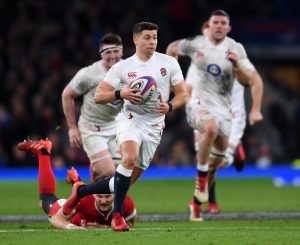
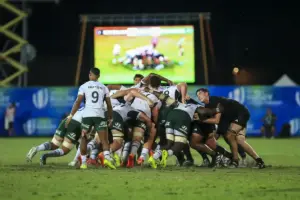
England’s Vannes warm-up delivered useful evidence for Steve Borthwick, but not the clean kind he would have wanted.
France XV beat England A 35-19 at Stade de la Rabine on Friday evening, turning a 14-12 half-time lead into a decisive second-half statement in a non-cap fixture designed to sharpen both nations before the July Nations Championship window.
On a night that began perfectly for England through Cadan Murley’s opening-minute try, the scoreboard eventually told a harder story. RugbyPass’ match centre recorded five France tries to England’s three, with Nicolas Depoortere, Gregoire Arfeuil, Nolann Le Garrec, Antoine Hastoy and Fabien Brau-Boirie all crossing for the hosts.
England started brightly but lost the middle of the game
England had reason to feel the exercise was worthwhile. Murley’s early finish gave them immediate reward, Marcus Smith struck just before the interval, and Max Ojomoh’s late try at least reflected the attacking talent Borthwick had placed around George Ford.
Yet the shape of the defeat matters more than the raw margin. France’s burst after half-time, with Le Garrec and Hastoy scoring in quick succession, changed the tone of the evening. England had entered the break only two points down. By the time Brau-Boirie scored late on, the match had become a reminder that summer auditions can expose as much as they promote.
That is why this result should be read alongside Alex Dombrandt’s No 8 audition. Dombrandt still produced moments on the gainline, and RugbyPass noted a strong carry from him after the break, but the wider England picture was more uneven. Back-row carrying, breakdown speed and second-half control will all feed into Borthwick’s thinking.
Ford and Smith gave Borthwick plenty to discuss
The Ford-Smith axis was always one of the most interesting parts of this fixture. Ford captained the side from fly-half, Smith started at full-back, and England’s best passages came when their playmakers had enough front-foot ball to stress France’s spacing.
Smith’s try before the break was a useful reminder of his instinctive running threat. Ojomoh’s late score, set up by Ford, showed England still had enough craft to punish loose defensive moments. The problem was that these flashes arrived around a French spell that looked more connected and more ruthless.
That will sting because George Ford had already framed this week around England’s pressure problem. This was not a Test match and it will not sit on any player’s cap record, but it did become another pressure reference point: an England side with plenty of senior quality started fast, stayed in range, then conceded control after the interval.
The result sharpens Monday’s selection call
The value of the Vannes fixture was never just the result. It was a live sorting exercise before the next squad decisions, and that context is why the free RugbyPass TV broadcast gave the game a wider stage. Supporters saw the same evidence Borthwick’s staff will now have to sift.
Murley helped himself with a sharp start. Ojomoh’s finish kept his name in the conversation. Smith’s positional flexibility remains both a weapon and a debate. Dombrandt’s ball-carrying still gives England a different No 8 profile. Caluori’s involvement, after another season of attacking noise around him, will be judged with the usual age-and-upside caveat rather than solely through one difficult away evening.
The danger for England would be treating this as a harmless run-out. France made it more than that. Their second-half acceleration turned Vannes into a proper selection filter, and England’s mixed response leaves Borthwick with evidence that is valuable precisely because it was uncomfortable.
That is the awkward usefulness of the night. England discovered players who can still influence games in flashes, but France showed how quickly a warm-up becomes a test of authority when the tempo lifts and the scoreboard starts to move.