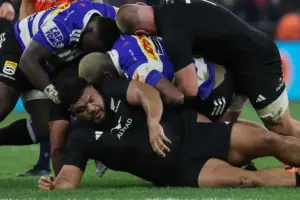
In rugby, a try can only be scored when the ball is grounded on or over the line.
If the ball is not successfully grounded, it is “held up”. This is a defensive tactic used by opposition teams to prevent their opponents from scoring at that moment, but also to ease the pressure being applied by the attacking teams.
The goalline dropout rule explained
When the ball is held up by the defensive team, they take a dropout from their own goalline. This will return possession to the team which had been attacking, but at a distance from the line. Traditionally, we see these dropout kicks go between 30 and 50 metres.
Before the introduction of the goalline dropout rule, attaching teams were given a five-metre scrum. This was a huge benefit to the attacking team and typically made it inconsequential if a team held the ball up, as the attacking team would be able to take advantage of their dominance sooner rather than later. The goalline dropout still gives the attacking team possession. However, it reduces the likelihood of scoring directly after they have been held up.
Common Scenarios: When is a ball considered held up?
The most common scenario for getting held up is traditionally during pick-and-go forward play around the base of the ruck. Defenders in these scenarios are typically able to set themselves as a pillar at the ruck. They can get their arms or bodies underneath the ball as an attacker attempts to drive over the line.
In these scenarios, it is also common to see attackers throw themselves at the line with the ball first. For defenders, there is no other option than to throw their bodies under the ball and attempt to hold the ball up off the line.
An interesting tactic by a defender who is choke-tackling just short of the line is to try to bring the attacker over the line. It will relieve the pressure and remove the chance of scoring from that area.
A referee will sometimes have to call held up if there is no clear evidence of a grounding in a try-scoring scenario. The TMO will try to find evidence of grounding, but if unable to, will stick with the on-field decision.
Tactical importance: Why “holding up” is a defensive win
Holding the ball up is a huge win for the defensive teams. It relieves pressure from the goalline area and shifts it more than 30 yards from the line.
Defenders are able to use their entire bodies to prevent the ball from touching the line or after it. The best example of the advantage that defences get from holding the ball up came as Toulon beat the Stormers in the Champions Cup round of 16. The Stormers were held up twice over the Toulon line in the last 10 minutes. The second time they were held up was with the clock in the red. This Charles Ollivon involvement meant that Toulon were able to progress to the Champions Cup quarter-final.