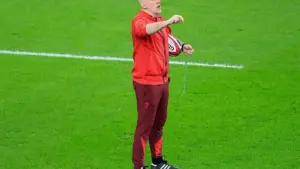
Rhys Carre has gone from a World Cup omission to the top of Welsh rugby’s honours list. The Saracens prop has been named the Welsh Rugby Writers’ Association’s men’s player of the season, with Sale centre Courtney Keight claiming the equivalent women’s award.
From World Cup Omission to Redemption: Rhys Carre’s Welsh Renaissance
Three years ago, Carre was not part of Wales’ plans at all. Warren Gatland left him out of the 2023 World Cup squad in France after he failed to meet the fitness targets set for him, a decision that ended his involvement at the tournament before it began.
Steve Tandy brought him back into the fold for the 2025 autumn series, and the loosehead has barely looked back since. His performances through the following season persuaded the voting panel of Welsh rugby journalists that he deserved their top individual honour.
Carre admitted the recognition had caught him by surprise. “It’s a bit surreal. I didn’t think this would be something I could achieve,” he said. He added: “It’s pretty cool and I just feel honoured that the Welsh rugby media think I deserve it.”
First Prop Since Gethin Jenkins: Breaking a 17-Year Award Drought
Carre’s award carries extra weight because of who last won it. No prop had taken the WRWA men’s player of the season title since Gethin Jenkins in 2009, a gap of 17 years that spanned an entire generation of Wales sides.
Front-row forwards rarely dominate individual awards, which tend to favour ball-carriers and try-scorers in the backline. Carre’s win therefore stands out as a rare acknowledgement of a prop’s all-round influence on a Test team, echoing our earlier analysis of Carre’s international return.
The wider WRWA honours list reflected strength across the Welsh game. Steffan Emanuel was named men’s young player of the year, Seren Lockwood won the women’s young player award, and Sion Parry took the Super Rygbi Cymru player of the season prize.
Those category wins sit alongside Carre and Keight’s senior awards as evidence that Welsh rugby’s talent pipeline is producing results at more than one level, even as the national side continues to rebuild.
Eleven Tests and Three Consecutive Tries: Inside Carre and Keight’s Record Season
The numbers behind Carre’s award are striking for a front-row forward. He started 11 of Wales’ 12 Tests in the 2025-26 season, an ever-present role that underlined how far his fitness and form had come since his 2023 setback.
He also scored three tries in three consecutive Tests during the 2026 Six Nations, an unusual return for a prop and one that turned heads well beyond the front row. One of those scores, a solo effort against Ireland in Dublin, has stayed with him.
“It’s a special memory,” Carre said of the try. He described the reaction it produced back home in England, where he now plays his club rugby. “There aren’t many Welsh people around where I live in St Albans, but there are a few and if I bump into them, people want to shake my hand, say congratulations and thank me for scoring that try.”
Keight’s season carried similar significance for the women’s game. The Sale centre made three starts at the 2025 World Cup before establishing herself as an ever-present at inside centre for Wales throughout the Six Nations that followed.
Her path into the sport was less conventional than most. “Going to university I knew I wanted to try something different and be in an environment where I was challenged and accepted – rugby was exactly that,” she said, reflecting on how her rugby journey began at Swansea University.
Winning the WRWA award has clearly meant a great deal to her. “It’s such a nice feeling to know that if you work hard, you can get to where you want to go,” Keight said, a sentiment that captures the arc of both players’ seasons.
World Cup Ambitions and the Long Road Ahead for Wales’ Rebuilding Squad
Both players’ awards arrive during a period Carre himself describes as one of rebuilding for the national side. Wales have endured a difficult run of results in recent seasons, and progress has come gradually rather than in dramatic leaps.
“Since I came back into the Wales squad, we’ve been in a rebuilding stage but we’ve shown steady progression since then,” Carre said. He was careful to frame that progress in realistic terms rather than overstate where the squad currently stands.
“We’re showing the people of Wales we’re slowly getting better and becoming more competitive in games. It takes a while for a team to come together,” he added, a message likely to resonate with supporters who have watched recent campaigns closely, as outlined in the latest international rugby round-up.
Carre’s own international story now stretches back to his debut in August 2019, followed swiftly by selection for that year’s World Cup in Japan as the youngest member of the squad, where Wales reached the semi-finals and finished fourth.
“It’s been eight years since my first one, which is crazy to say,” he reflected, a reminder of how much has changed for him since that breakthrough as a teenager. The 2023 omission remains part of that story, but it no longer defines him.
Looking ahead, Carre was measured rather than presumptuous about what comes next. “If I keep going the way I’m going, I’ll be happy. It’d be good to hopefully get to the World Cup,” he said, stopping well short of assuming his place is already secured.
For now, the WRWA award stands as confirmation of a remarkable turnaround, one built on hard work rather than certainty about what lies ahead. Full detail on the awards and both players’ comments can be found in BBC Sport coverage of the WRWA awards.
With Carre and Keight both playing key roles for Wales through a demanding period, their awards offer a marker of individual progress inside a squad still finding its identity. Whether that progress translates into selection for the next World Cup cycle remains to be seen, but neither player is short of the drive to find out.