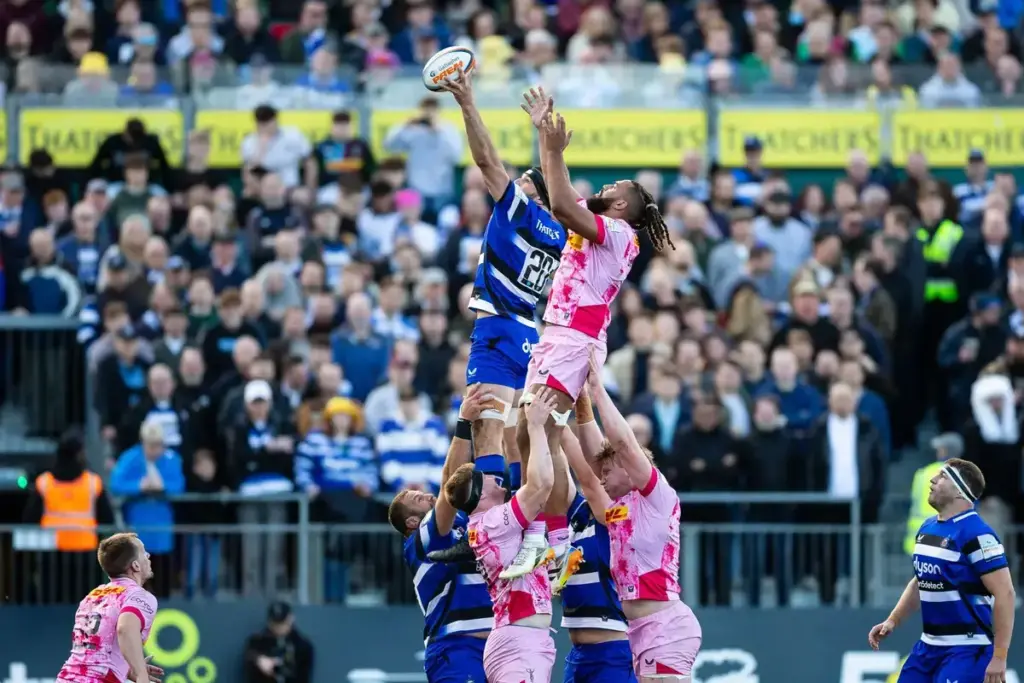

The lineout is one of a few forms of restart union it is used when the ball crosses the sideline.
What is a lineout in rugby union?
The lineout is a set piece where the ball is thrown from the touchline back into play. Both teams put players into the lineout to try to win the ball. The attacking team decides how many players can go in for each side. The hooker throws the ball into the middle of the two lines, and players from either side are lifted to compete for the ball.
The roles: jumpers, lifters and the Hooker
There are three types of players involved in a lineup. The hookers throws the ball and requires perfect timing with his jumpers. The most common throw sees the hooker pull the ball back behind the head and over the body, throw into the line. The jumpers and lifters work in sync. Any of the players in a lineout can jump, but can also lift.
Working as a pod of three, two players will lift a teammate in the air. This maximises the height out of the line and tries to create situations where the ball can be caught freely without competition.
Typically, the scrum half sets at the base of the lineout outside of the line and passes the ball away when the lineout is complete.
Key lineout rules that every fan should know
The two lines of the lineout must be separated by one metre in a lineout with the hooker throwing down the middle of the two lines. If a team closes the one metre gap or doesn’t throw straight, a free kick will be awarded.
While a lineout throw must be straight, it will only be penalised if the opposition team are in the air to compete.
The ball must go over the five-metre linefrom a lineout throw, otherwise it will be penalised.
When a player is put into the air, the number one priority is safety, and therefore, you are are not allowed to make contact or interfere with the player who is in the air or the players who are lifting them.
Common lineout tactics and signals
The attacking team can change the number of players in the lineout. The most common number in the line out is seven players. This is the full forward pack, with the hooker taken out to throw. Some teams put as little as three in the lineout which is just one jumper and two lifters. Players are allowed to shuffle their position in the line in order to take the opposition by surprise.
Teams can also set up a maul off a lineout, the players in the lineout come together in a group and try to drive the ball forward.
Teams will pre-call a lineout. On telvevision you will see the forwards gather together in a circle to decide what they are going to do at the lineout. A player will then go and deliver the call to the hooker who will be at the touchline getting the ball prepared. The team will then start their movement off a set signal or sign. If the option is being defended by the opposition they will have a backup set of calls which they will be able to move to instead.
Why the lineout is a vital set piece
The line note is a massive set piece for building momentum. A typical tactic in rugby is to kick a penalty to touch and attack again from a lineout. This allows the attacking team to keep the ball. Lineouts allow for a set-piece attack or strike-play for the back line. These opportunities allow teams to go for line breaks and create one-on-one matchups to break the gain line. Teams will also have three to five phases planned out as a strike-play, as a lineout is one of the very few times that every player is in a set position.





Comments.
Loading comments…