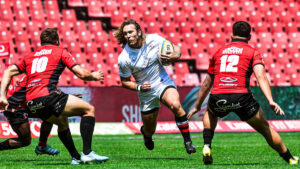
Mounting pressure is forcing administrators to reconsider their approach to set-piece officiating following fierce backlash from front-row veterans. The mandatory brake-foot regulation, designed to reduce neck strain by requiring hookers to place one foot in the tunnel before engagement, is now facing intense scrutiny. The debate ignited after New Zealand were repeatedly penalised for pre-engagement infractions during their recent clash with the 2023 Rugby World Cup champions, South Africa during the Rugby’s Greatest Rivalry tour.
Addressing Front Row Safety Concerns
Former international forward Jeremy Paul has issued a stark warning regarding the physical realities of modern Scrum Rules. Introduced four years ago to limit axial loading, the current mandate forces the number two to keep a foot planted flat. However, front-row specialists argue that this compromises spinal alignment when absorbing immense weight.
Speaking on the GBRANZ podcast, Paul expressed his fury over the physical disconnect between lawmakers’ intentions and pitch-level mechanics. He told Planet Rugby that the legislation is inherently “dangerous” for players.
“That is dangerous as hell, you’ve got 900 kilos behind you. We’re going to go back to 5ft 5in hookers because anyone over 6ft 2in, you’re going to struggle,” Paul argued.
The veteran forward explained that players naturally need to stay on their toes to brace safely. By forcing a flat foot, officials are placing them in a vulnerable position.
While a flat foot reduces the chance of a scrum collapse, it allows the defensive team to put an extra players worth of pressure on the hit. This therefore actually increases the force being put directly on the player in the middle.
“What they’re asking you to do is come up over your front foot, they’re asking you to plant your front foot. It’s actually an incredibly hard thing to do to leave your foot there because you’re not actually going in straight and safe,” he added.
Frustration over the regulations prompted a harsh assessment of the governing body’s decision-making process.
“Whichever idiot in World Rugby decided to bring this rule in about brake foot, you are up for a massive, massive hurt here where it’s dangerous, it’s absolutely dangerous. You can’t have the hookers having a flat foot when the other seven players are on the balls of their feet,” Paul stated.
Reassessing Modern Scrum Rules For Officials
The strict enforcement against New Zealand has triggered widespread debate about whether referees are focusing on the wrong technicalities. After New Zealand made pack changes in Cape Town, All Blacks forwards coach Neil Barnes dismissed the pre-engagement regulation entirely, claiming that “no one gives a s*** about” it. It is a rule that is rarely enforced by referees, but was in this case.
Former New Zealand captain Kieran Read echoed these sentiments, suggesting that fans and players are frustrated by constant resets for minor infractions rather than actual safety hazards.
“It’s a pointless thing too, it makes no difference. What you want is a scrum up and square, you want it up off the ground, so no matter how it gets there, keep it up, get it going,” Read noted. He added: “People don’t want to watch the reset. You want a contest, yes, the contest has got to be there, but don’t go looking for something.”
Calls have been made in recent years to shift towards a Rugby League approach where resets are minimal as the contest is rarely a thing. This would have major implications on the game and would take away from the beauty of the all shapes and sizes nature of rugby union. There would no longer need to be props like we currently have and teams would opt for a pack filled with back row style players. This would also impact the tactical variety of the game as the current role of the South African pack has given them the ability to be the best platform in the world.
Prioritising Loosehead Hip Alignment Defensively
Rather than obsessing over the brake foot, analysts insist that officials must monitor the defensive loosehead prop to prevent collapses. Paul believes that simplifying the refereeing criteria would naturally eliminate illegal angles and the “walking around” tactic.
Fan footage has been clear over the last few weeks showing the difference in set up by Ox Nche on attacking and defensive ball with a wide base, putting his left foot wider than opposition on attacking ball.
“It’s everything to do with your hips in a scrum. As soon as your hips start to split, that’s when you start to splinter,” he explained.
The mechanics dictate that a loosehead must maintain a tight bind with their hooker to drive straight. When defending opposition ball, props often widen their stance and detach their hips to disrupt the attacking platform.
“In terms of when it’s your ball… the loosehead is channel one and they’ve got to keep their hips close to the hooker. As soon as it’s opposition ball, they will kick their hips out because they’ve got nowhere else to go,” Paul said.
If referees focus purely on the structural integrity of the prop-hooker bind, the set piece could become safer and more fluid. This shift in officiating focus might prove crucial when combating Springbok scrum power in future fixtures. The chorus of prominent voices demanding change ultimately puts immense pressure on World Rugby to rethink how they manage set-piece safety.