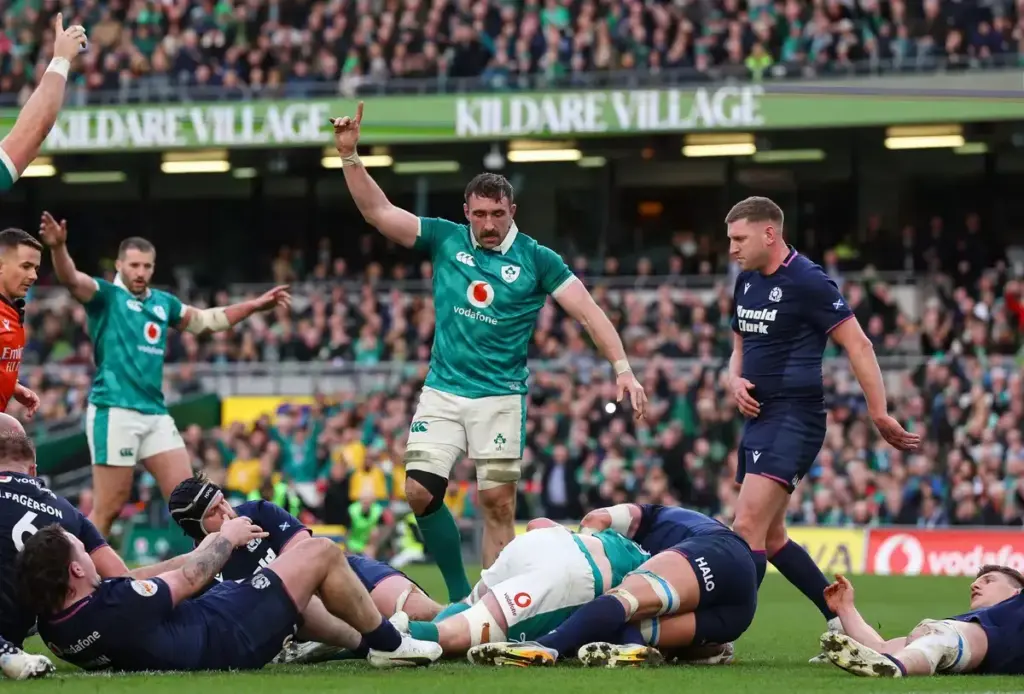

Ireland travel to Australia to start their Rugby Nations Championship campaign. The squad travels without their captain, Caelan Doris, and Tommy O’Brien, who picked up injuries in the URC final against the Bulls.
Ireland Starting XV Headline Stats Table
| Jersey | Position | Player | Province | Key Stat / Note |
| 15 | Fullback | Hugo Keenan | Leinster | Star fullback who scored the crucial winning try at the MCG during the 2025 Lions Tour. |
| 14 | Right Wing | Robert Baloucoune | Ulster | An explosive weapon out wide; awarded the “Rising Star of the Six Nations”. |
| 13 | Outside Centre | Garry Ringrose | Leinster | Highly experienced midfield anchor and defensive captain in the backline. |
| 12 | Inside Centre | Stuart McCloskey | Ulster | Provides crucial physical presence, direct ball-carrying, and offloading power. |
| 11 | Left Wing | Jamie Osborne | Leinster | Versatile back who cemented his spot by starting every game of the Six Nations campaign. |
| 10 | Fly-half | Sam Prendergast | Leinster | Handed the starting No. 10 jersey for this major Southern Hemisphere test. |
| 9 | Scrum-half | Jamison Gibson-Park | Leinster | The tempo-setting heartbeat of the Irish attack, returning Test star from the Lions series. |
| 1 | Loosehead Prop | Tom O’Toole | Ulster | Dynamic front-rower stepping up into the starting loosehead side for the Sydney clash. |
| 2 | Hooker | Dan Sheehan (C) | Leinster | Match Captain; world-class hooker and prominent frontline star of the 2025 Lions squad. |
| 3 | Tighthead Prop | Tadhg Furlong | Leinster | The veteran anchor of the Irish scrum with extensive international and Lions test pedigree. |
| 4 | Lock | Joe McCarthy | Leinster | Heavy-hitting, high-impact tight-five enforcer who starred in the 2025 Test series. |
| 5 | Lock | James Ryan | Leinster | Former national captain and primary lineout caller returning to top form. |
| 6 | Blindside Flanker | Cian Prendergast | Connacht | Hard-nosed back-rower starting alongside his younger brother, fly-half Sam Prendergast. |
| 7 | Openside Flanker | Josh van der Flier | Leinster | Former World Rugby Player of the Year; relentless defensive engine at the breakdown. |
| 8 | Number 8 | Jack Conan | Leinster | Powerhouse carrier bringing immense big-game experience to the back-row. |
Key Data Insights
- The Brotherly Connection: This match marks a rare international milestone with brothers Sam Prendergast (10) and Cian Prendergast (6) both named in the starting forward and back units.
- Leinster Dominance: Head coach Andy Farrell has relied heavily on continuity, selecting 12 Leinster players in the starting 15, supplemented by 2 from Ulster and 1 from Connacht.
- Captaincy: With typical leaders rotating or managing workloads post-Lions tour, hooker Dan Sheehan officially steps up to captain the side from the front row
The launch of the inaugural Nations Championship has brought the rugby world to a fascinating intersection in the Southern Hemisphere. On Saturday, 4 July 2026, Allianz Stadium in Sydney plays host to a heavyweight clash rich with narrative subplots, tactical gambles, and historical weight.
This match represents a profound transition for both sides. For Australia, it marks the beginning of the final chapter under Joe Schmidt before he hands the reins to Les Kiss later this year. For Ireland, Andy Farrell is tasked with navigating a squad missing several era-defining superstars due to injury and structural change.
1. Ireland’s Selection Anatomy: Continuity Meets Calculated Risk
Looking closely at the Irish lineup presented in image.png, Andy Farrell has leaned heavily into provincial familiarity while simultaneously rolling the dice on a few key positions. The starting XV is overwhelmingly dominated by a 12-strong Leinster contingent, providing Ireland with an organic club-level cohesion that is invaluable when playing away from home at the start of a gruelling Southern Hemisphere tour.
The Pundit Backlash and Praise
Rugby pundits have immediately zeroed in on two major tactical talking points within this starting fifteen:
- The Tom O’Toole Experiment: Prominent analysts, including former international Bernard Jackman, have noted that starting Ulster’s Tom O’Toole in the loosehead jersey is a calculated gamble. O’Toole spent almost his entire domestic season operating exclusively at tighthead for Ulster. However, after a few promising cameos on the left side of the scrum during the tail end of the Six Nations, Farrell is backing him to fill the void left by injured stalwarts like Andrew Porter.
- The Post-James Lowe Era: The left-wing vacancy left by James Lowe—who recently departed Irish rugby following contract negotiations—has been filled by Jamie Osborne. Pundits like Murray Kinsella have pointed out that while Osborne spent the Six Nations shifting seamlessly into fullback, his move to the wing allows the returning Hugo Keenan to reclaim his customary No. 15 jersey. Osborne’s frame and booming left foot will be vital in replicating Lowe’s traditional clearing role.
- The Brotherly Tandem: A heartwarming but tactically intriguing storyline is the inclusion of the Prendergast brothers. With Sam orchestrating at fly-half and Cian bringing his trademark abrasive edge to blindside flanker, Ireland features a rare family axis that adds unique emotional energy to the opening Test.
2. The Wallabies’ Strategy: Youth, Breakthroughs, and an Emergency SOS
Turning our attention to Joe Schmidt’s Australian squad is a fascinating blend of experimental youth, returning outcasts, and emergency structural insurance
Schmidt has rarely been a coach to make erratic decisions, but the Wallabies’ team sheet signals an aggressive desire to unearth a modern identity. The most glaring headline is the selection of Jock Campbell at fullback, ending a nearly four-year international hiatus. Pundits in Australia view this as Schmidt rewarding pure Super Rugby form, choosing Campbell’s reliable positional play over raw athleticism.
In the midfield, the pairing of Len Ikitau and rugby league convert Joseph-Aukuso Suaalii gives Australia an incredibly balanced centre combination. Suaalii’s aerial dominance and offloading ability will lock horns directly with Ireland’s robust defensive partnership of Stuart McCloskey and Garry Ringrose.
Perhaps the biggest indicator of the pressure mounting on the Wallabies’ front row is the bench selection of James Slipper. Having initially stepped away from the international arena, Slipper answered an emergency SOS call from Schmidt to provide crucial prop cover against a feared Irish scrum.
3. The Playmaker Paradox: Sam Prendergast vs. Carter Gordon
There is no position on a rugby pitch subjected to more intense scrutiny than fly-half, and this match features two young playmakers tasked with steering their respective nations into the future.
Sam Prendergast (Ireland)
Prendergast enters this match with the ultimate redemption narrative. After starting the Six Nations in the No. 10 jersey, he was dropped for the final three rounds as Jack Crowley took over. However, following a masterful conclusion to the domestic season where he drove Leinster to a United Rugby Championship title defence, and with Crowley currently sidelined by injury, the keys to the kingdom have been returned to him.
Prendergast is a classic modern virtuoso: he prefers to play with deep depth, utilising a world-class tactical kicking game to pin opponents back while trusting his passing vision to unleash the runners outside him.
Carter Gordon (Australia)
Directly opposing him is Carter Gordon, a fly-half cut from entirely different cloth. Gordon thrives in chaos and close-quarters combat. Under Schmidt, Gordon is expected to play incredibly flat to the defensive line, using his explosive running threat to pull defenders inward before releasing the lightning-quick outside backs like Max Jorgensen and Dylan Pietsch.
The Tactical Verdict
Pundits view this matchup as a classic clash of styles. If Prendergast can dictate the tempo alongside his club scrum-half Jamison Gibson-Park, Ireland will slowly suffocate the Wallabies with structured territory. However, if Gordon can disrupt the breakdown and turn the game into an unstructured, high-paced transition battle, his running game could expose an Irish back-line adjusting to new combinations.
4. Leading From the Front: Dan Sheehan vs. Harry Wilson
With iconic captains like Caelan Doris missing the tour for Ireland, both coaches have appointed dynamic, lead-by-example forwards to wear the captaincy armband.
Dan Sheehan (Ireland)
Wearing the hooker jersey and the captaincy band, Dan Sheehan represents the absolute gold standard of modern front-row play. Sheehan isn’t just a set-piece anchor; he regularly operates as a functional extra winger in wide channels, possessing footwork and top-end speed that defy his size. As a captain, Sheehan faces the immense challenge of managing referee Ben O’Keeffe while operating in the exhausting, attritional environment of the front row. He will need to rely heavily on veteran teammates like Tadhg Furlong and James Ryan to maintain structural discipline across the park.
Harry Wilson (Australia)
Conversely, Harry Wilson commands the Wallabies from the base of the scrum at Number 8. Wilson’s captaincy style is defined by a relentless work rate and high-volume ball carrying. He is the physical heartbeat of the Australian pack. Unlike Sheehan, who picks his moments to strike out wide, Wilson works primarily in the tight, dirty areas of the field, generating the quick ruck ball that Carter Gordon desperately needs to activate the backline.
The Captaincy Contrast
The captaincy battle will ultimately be won or lost at the breakdown. Sheehan’s primary objective will be ensuring Ireland’s defensive line remains disciplined and unyielding, while Wilson will try to use his loose-forward freedom to relentlessly pressure Ireland’s ball security.
5. The Bench Strategy and Final Verdict
A final glance at the respective benches confirms a distinct philosophical difference between Andy Farrell and Joe Schmidt.
Farrell has opted for a highly traditional, control-oriented 5-3 bench split. By holding back elite operators like Tadhg Beirne and Bundee Aki, Ireland possesses late-game levers designed to completely choke out the game or stabilise an emergency situation. It is a bench built for control, not chaos.
Schmidt’s bench is far more volatile. The inclusion of “Tongan Thor” Taniela Tupou and the unretired James Slipper indicates that Australia plans to completely reinvent their front-row dynamic at the 50-minute mark, turning the scrum into a late-game weapon.
Ultimately, pundits give the edge to Ireland’s systemic cohesion, but warn that if Joe Schmidt’s young Wallabies can click early at Allianz Stadium, the unpredictable nature of this Australian team could trigger a massive opening-round shock in the Nations Championship.
Comments.
Loading comments…