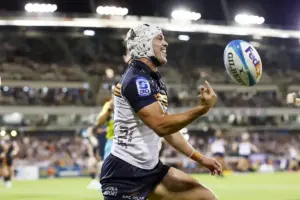
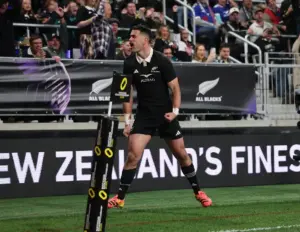
The All Blacks start their spell under Dave Rennie by welcoming the Six Nations champions France to the One NZ Stadium for the first-ever international in the stadium.
All Blacks Starting 15: Headline Stats & Lineup
| Jersey | Player | Position | Test Caps | Franchise/Club | Key Feature / Tactical Role |
| 1 | Ethan de Groot | Loosehead Prop | 40 | Highlanders | Physical anchor of the front row |
| 2 | Codie Taylor | Hooker | 106 | Crusaders | Centurion veteran and primary lineout thrower |
| 3 | Fletcher Newell | Tighthead Prop | 35 | Crusaders | Elite scrummaging powerhouse |
| 4 | Josh Lord | Lock | 12 | Chiefs | High-stature aerial option at the lineout |
| 5 | Sam Darry | Lock | 8 | Blues | Athletic and mobile engine-room enforcer |
| 6 | Peter Lakai | Blindside Flanker | 8 | Hurricanes | Dynamic 2026 Super Rugby Pacific champion |
| 7 | Luke Jacobson | Openside Flanker | 24 | Chiefs | Hard-hitting defensive asset and breakdown scavenger |
| 8 | Ardie Savea (C) | Number 8 | 106 | Hurricanes | World-class team captain and premier ball carrier |
| 9 | Cam Roigard | Scrum-half | 17 | Hurricanes | Tactical kicker with rapid service from the ruck |
| 10 | Ruben Love | Fly-half | 5 | Hurricanes | Playmaker; 2026 Super Rugby Final POTM |
| 11 | Caleb Clarke | Left Wing | 33 | Blues | High-impact powerhouse finisher on the edge |
| 12 | Jordie Barrett | Inside Centre | 78 | Hurricanes | Direct distribution link with massive boot capacity |
| 13 | Quinn Tupaea | Outside Centre | 24 | Chiefs | Physical midfielder adept at busting the gainline |
| 14 | Will Jordan | Right Wing | 54 | Crusaders | World-class strike rate and lethal space creator |
| 15 | Damian McKenzie | Fullback | 74 | Chiefs | Counter-attacking spark plug covering the backfield |
Squad Highlights & Key Data
- Total Starting Experience: The starting 15 boasts a combined 624 international test caps, offering a balanced mix of raw youth and veteran leadership.
- The Centurion Core: Captain Ardie Savea and hooker Codie Taylor lead the experience tally, matching each other exactly at 106 test caps apiece.
- Tactical Shift: This match marks a fresh era under head coach Dave Rennie, who handed the fly-half keys to rising star Ruben Love following his stellar Super Rugby campaign.
The international rugby calendar has officially entered a brave new era. The arrival of the inaugural Nations Championship in 2026 has effectively banished the old, low-stakes mid-year friendlies, replacing them with a cutthroat, tournament-style battleground where every single test match carries immense weight. For New Zealand, the stakes could not be higher for their opening blockbuster clash. This weekend, the All Blacks line up against their ultimate northern hemisphere rivals, France, in a match that promises to set the tactical tone for the rest of the international season.
As revealed in the official squad announcement graphic designated in image.png, the New Zealand coaching staff has named a fascinating Match Day 23. It is a team sheet that perfectly encapsulates the strategic direction of modern Kiwi rugby: a calculated blend of battle-hardened centurions, a high-octane loose forward trio, and a profoundly daring changing of the guard in the playmaker positions. With foundational injuries forcing their hand in the tight five, and a clear tactical desire to play at a breathless tempo, this selection tells a compelling story of where the All Blacks stand in 2026.
The Tight Five: Mitigating Injury and Matching French Mass
Any rugby tactician knows that a test match against Les Bleus is won or lost in the dark, brutal spaces of the front and second rows. The French pack is historically massive, relying on heavy scrum pressure and destructive close-range carries to suffocate opponents. Looking at image.png, the All Blacks have named a front row designed to anchor the set-piece while offering maximum mobility in open play.
Ethan de Groot starts at loosehead, tasked with neutralising the formidable French tighthead side. Beside him is the venerable Codie Taylor at hooker, whose 100+ caps of international experience will be absolutely vital in managing a relatively young tight five. Fletcher Newell rounds out the front row at tighthead, bringing his elite Super Rugby scrummaging form to the international stage to ensure the All Blacks maintain a rock-solid platform at the set-piece.
The real talking point of the forward pack, however, lies in the second row. A crucial footnote at the bottom of image.png notes that athletic lock Tupou Vaa’i is completely unavailable due to injury. In his absence, the coaching staff has handed the engine room keys to a youthful but highly promising pairing:
- Josh Lord (4): Standing as an imposing aerial target, Lord’s primary mandate will be disrupting the French lineout and securing clean first-phase ball for his halfbacks.
- Sam Darry (5): The dynamic Blues lock steps into the starting five, bringing a massive engine, relentless work rate around the park, and the physical edge needed to halt France’s close-quarter rolling mauls.
The Loose Forwards: Savea’s Shield and the Back-Row Balance
Perhaps the most balanced and terrifying segment of this team sheet is the back row. Led by world-class talisman Ardie Savea (8) wearing the captain’s armband, the All Blacks’ loose forward trio presents an intriguing mix of defensive steel and explosive post-contact meters.
With Savea locking down the scrum at Number 8, the selectors have opted for a fascinating tactical configuration on the flanks. Peter Lakai gets the nod at blindside flanker (6). Lakai has been the breakout forward of the 2026 domestic season, possessing an extraordinary ability to break tackles, offload in heavy traffic, and act as an auxiliary link-player in wider channels.
Complementing Lakai’s explosive running is the gritty Luke Jacobson at openside flanker (7). Choosing Jacobson—traditionally a blindside or blindside/Number 8 hybrid—at the number 7 jersey indicates a very specific tactical intent. Rather than utilizing a traditional, lightweight ball-scavenger over the ruck, the All Blacks want a dual-hitting defensive wall. Jacobson’s role will be to chop down heavy French carriers right at the gainline, slowing down their breakdown ball through sheer physical dominance rather than subtle hand-trips.
The Tactical Axis: A New Era Playmaking System
If the forward pack selection is about survival and stabilisation, the backline selection is a declaration of total offensive war. The halfback and fly-half axis named in image.png represents a thrilling generational shift that Kiwi fans have been eagerly anticipating.
At scrum-half, the electric Cam Roigard gets the start. Roigard’s game is built on sharp tactical kicking, snappy distribution, and a highly dangerous running game around the fringes of the ruck. If the French defenders fall asleep around the historical fringes, Roigard has the size and speed to punish them directly.
The biggest headline of this team list, however, is the inclusion of Ruben Love in the coveted number 10 jersey. Trusting Love with the fly-half responsibilities against a team as tactically astute as France is a massive vote of confidence. Love brings a completely unpredictable, intuitive style of playmaking to the field. He possesses a devastating step, an elite acceleration rate, and a profound ability to play flat to the line, challenging defenders to commit before unleashing his outside backs.
By pairing Roigard and Love, the All Blacks are signalling an intent to play a hyper-speed, intuitive brand of rugby, designed to tire out the heavy French defensive line by shifting the point of attack with rapid-fire efficiency.
The Midfield and Outside Backs: Power, Pace, and Aerial Supremacy
Outside of the young playmaking axis sits a backline dripping with lethal finishing ability, physical power, and tactical kicking insurance.
In the midfield, Jordie Barrett holds down his customary inside centre (12) role. Barrett is the glue of this backline; his booming boot provides an invaluable exit option, while his direct running line creates a reliable target to get over the gainline. Partnering him at outside centre is Quinn Tupaea (13), a powerful, direct runner who excels at fracturing defensive lines and creating rapid second-phase ball.
The back three selected for this weekend is arguably the most lethal combination available in world rugby today:
- Caleb Clarke (11): A human wrecking ball on the left wing, Clarke’s role will be to generate forward momentum from kick-returns and finish aggressively in tight spaces.
- Will Jordan (14): Operating on the right wing, Jordan remains an absolute maestro of spatial awareness. His uncanny ability to pop up in the middle of the park and sniff out a try-scoring opportunity makes him a constant headache for northern hemisphere defences.
- Damian McKenzie (15): By positioning McKenzie at fullback rather than fly-half, the coaching staff has unlocked a lethal “dual-playmaker” system. McKenzie can chime into the line as a second first-receiver, relieved of the heavy defensive organising duties of a number 10, allowing him to attack fractured defences from deep with his trademark chaotic brilliance.
The Impact Bench: The Finishers and Debutants
Modern test matches are rarely won by the starting fifteen alone; the final thirty minutes belong to the bench. The replacements provide an excellent mixture of seasoned veterans to steady the ship and dynamic young athletes to inject late-game energy.
The front-row cover features the explosive Asafo Aumua (16) alongside the highly reliable Tyrel Lomax (18). Joining them is a potential debutant in Xavier Numia (17*), whose stellar domestic scrummaging form has finally earned him a shot at international honors. The second and loose forward row cover is immense, boasting the vast experience of Patrick Tuipulotu (19) to bring calm physical authority to the late stages, and the young phenom Wallace Sititi (20), who can cover multiple positions across the back row with his explosive carrying.
In the backs, Cortez Ratima (21) stands ready to maintain the high-tempo service at scrum-half, while Billy Proctor (22) provides premium defensive coverage across the midfield. Finally, the backline cover is rounded out by another potential debutant, the incredibly exciting Fehi Fineanganofo (23*), a young outside back capable of tearing a tired defensive line to shreds in the dying embers of the match.
Final Match Outlook
This Match Day 23 is a calculated gamble by the All Blacks coaching staff. By embracing a high-tempo loose forward trio and an incredibly young, dynamic playmaking axis in Roigard and Love, New Zealand is daring France to try and keep pace with them over eighty minutes. If the young tight five can hold their own at the scrum and withstand the early physical onslaught from the French pack, the sheer speed, creativity, and finishing power running rampant through this Kiwi backline should lay the foundation for a spectacular, historic victory to kick off the 2026 Nations Championship.