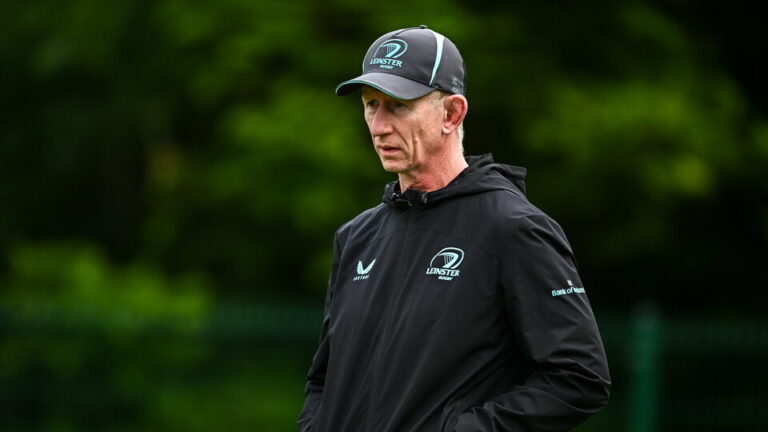
Leo Cullen’s Leinster farewell now has a date, and that gives one of European rugby’s most stable machines a very different kind of pressure.
Leinster have confirmed that Cullen will step away from his role as head coach at the end of his current contract, which runs to the conclusion of the 2026/27 season. It is not an abrupt exit and it is not a mid-cycle rupture, but it is still a major marker in the province’s modern story.
For a club that has become used to planning years ahead, the announcement gives Leinster time. It also removes any ambiguity. The next campaign will not simply be another title defence. It will be Cullen’s final season in charge, a long succession runway for the IRFU and Leinster, and a test of whether the province can turn stability into renewal.
A rare moment of change for Leinster
Cullen has been part of the Leinster fabric for most of his adult life, first as a player and then as the coach who carried the province through a decade of relentless expectation. Since taking charge in 2015, he has overseen domestic dominance, repeated European final appearances and a player-development system that continues to feed Ireland at Test level.
That is why the timing matters. Leinster have just come through another season in which the emotional swings were stark: European frustration, familiar external noise, and then the authority of a URC finish that again reminded everyone how hard they are to live with when their game is aligned.
ReadRugbyUnion looked at the title response through Josh van der Flier’s honest Leinster reset, and Cullen’s decision now places that response in a wider frame. This is not just about celebrating another trophy. It is about managing the end of a coaching era without letting the edge soften.
The succession question starts now
Leinster’s next appointment will be one of the most scrutinised provincial decisions in Irish rugby. The job demands more than a polished CV. It requires someone who can handle a squad full of internationals, keep academy production moving, work inside the IRFU system and still find a way to win the biggest European matches that have slipped away too often in recent years.
Jacques Nienaber’s role inevitably forms part of that conversation, not least because Leinster’s defensive identity has sharpened during his time in Dublin. But succession at Leinster is rarely just a name game. The province’s strength has always been structure: the academy, the schools pathway, the senior leadership group and the ability to refresh without losing standards.
That same structure was visible before the Croke Park decider, when the province’s depth and Test-class core made the Sam Prendergast-Handre Pollard control battle feel closer to international rugby than a routine club final. Cullen’s successor will inherit that advantage, but also the burden that comes with it.
Cullen still has one more season to shape
The danger with a long goodbye is drift. Leinster cannot afford that. Their standards are too public, their squad is too loaded, and the European question remains too loud for the next season to become a testimonial tour.
Cullen’s final campaign should instead sharpen the room. Players know the end point. Coaches know the transition clock has started. The province knows it has a rare chance to manage change from a position of strength rather than scramble after a sudden departure.
That matters for the younger core as much as the established internationals. The next Leinster era will still be shaped by the likes of Prendergast, Joe McCarthy, Jack Boyle and the rest of the emerging group asked to carry the province beyond the old reference points. The recent Leinster and Bulls team-news picture showed the level of talent already in place.
Cullen has given Leinster clarity. What they do with it will define not only his final year, but the first steps of whatever comes next.