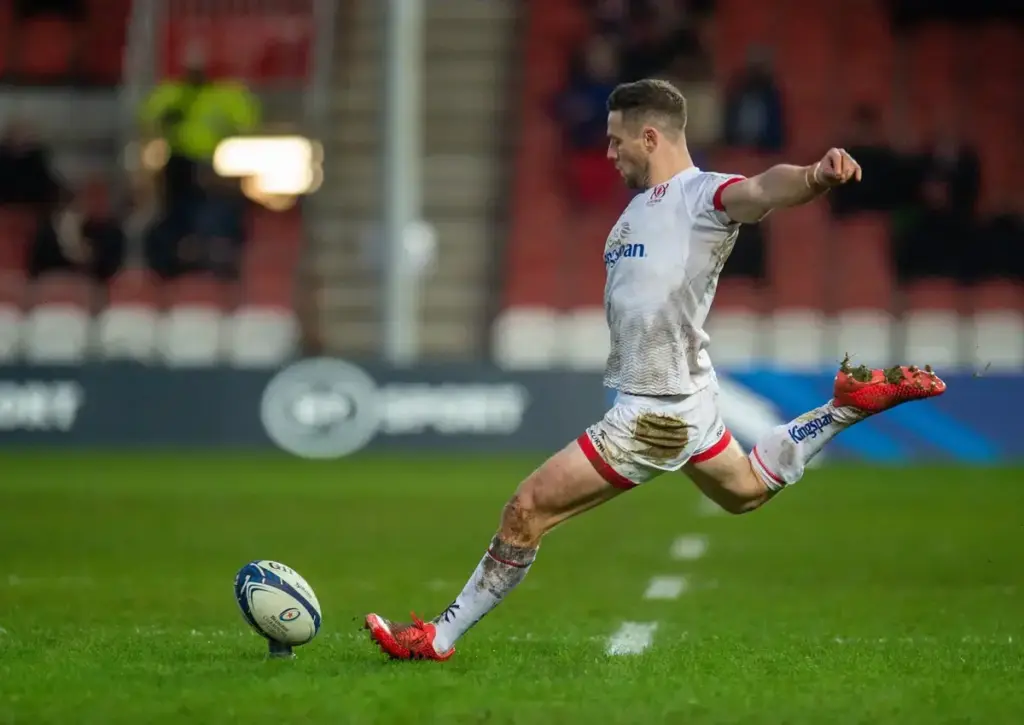

Goalkicking is one of the most notable improvements as you go up the levels in rugby. At the amateur level, goal kicking becomes quite unreliable. Professionals are expected to be perfect nearly every time.
In rugby, there are two opportunities to kick at goal. Firstly, after a try has been scored, the goal kicker will get a conversion attempt, which would add two points to the score. When a team receives a penalty, they can opt to kick at the goal. If the ball goes between the posts and over the bar, they receive three points. Goalkicking is one of the most individual parts of rugby. Play stops, and no one else is involved.
Establishing a reliable pre-kick ritual
Goalkickers have their own routine. If you want to become a goal kicker, it’s important that you come up with a routine that makes you feel comfortable. A professional will have their routine that they have worked on for many hours, days, weeks and even years. They work to improve this all the time.
In rugby, kickers have 60 seconds to place the ball, complete their routine and kick. It’s important for kickers that they practice using different amounts of this time. For some game states it is useful to take as much of that time as possible. This could be in the final play when the match is won or to get to halftime. There are also occasions where the goalkicker may need to kick the ball quickly, for example, if they are behind and need to get the match restarted quickly. The optimal routine lasts somewhere between 30 and 50 seconds. The key for kickers at this time is slowing their breathing down, as kicking is all about accuracy. You will see professionals take deep breaths to slow down their heart rate, and they may have other superstitious movements.
Foot-to-ball contact: finding the “sweet-spot”
The key to kicking a rugby ball is all about the point of contact. This sets the trajectory and power as a ball leaves the boot. The sweet spot of a rugby ball is on the bottom half, about halfway down. This allows the kicker to use the curvature of the ball to send it at a prime trajectory, but also generate the most power. Some kickers like to set up the ball at different angles. This is something Sam Prendergast has recently changed, which made a big difference to his kicking off the tee. Again, this is all about comfort for the kicker. Setting up the ball the way that they like is the best for them. Some kickers like to use different tees, lower tees and higher tees and also tees which hold the ball in different ways.
Wind and environmental factors
As a winter sport, the environment is always going to play a massive factor as the ball flies through the air. The wind can cause a huge amount of movement for the ball. Kickers need to practice aligning for the wind in all sorts of directions that should also play a factor in a w decision-making on whether to kick a penalty or not.
If the wind is behind a kicker, they could opt to kick a penalty from further out. If the wind is into their face again, they may have to decide to kick only penalties which are closer to the posts. If the wind is moving across the pitch in either direction, kickers may decide not to kick at all or only if the kick is simple. For conversions, the kick distance is typically around 22 m, and therefore they simply need to allow for the direction of the wind.



Comments.
Loading comments…