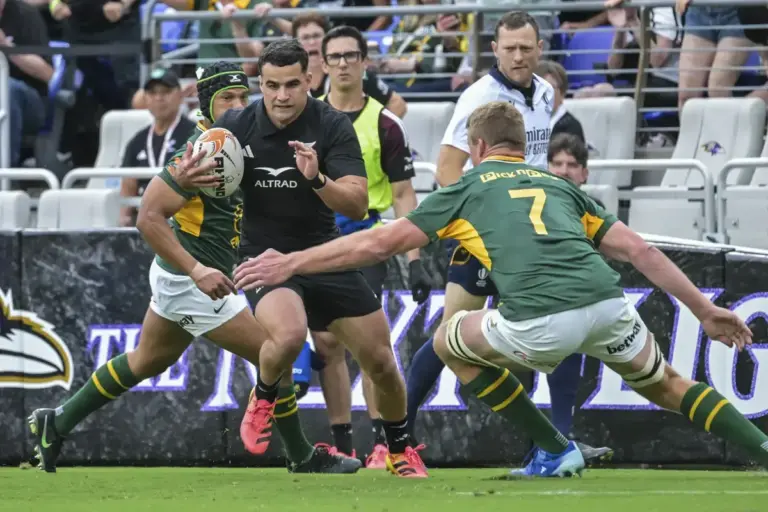
Passing in rugby is the fundamental skill that all players in all positions must master.
Passing can range in the distance the ball must be thrown, and therefore, having a variation of passing techniques is crucial in the development of young players. To throw the ball short distances, a “pop” pass is the most efficient. The key rule to follow in all of these passing techniques is to ensure that the ball travels backwards. If the ball travels forward from a pass, a scrum is awarded to the opposition.
Hand placement and the “flick” technique
When delivering a pass, having the ball ready to be passed, understanding the variables at hand is crucial when deciding how to pass the ball. For close-range passes of less than a metre, technique is not the most important, as the quick transfer of the ball from player to player is the most important detail.
When trying to give a long pass, hand placement is crucial. When passing left, the right hand of the player will be at the back of the ball, and when passing to the right, the left hand will be at the back of the ball. This hand generates the power in the pass. The use of a high elbow on this side also helps to keep the flight of the pass flat.
The other hand goes to the front of the ball and is used for directing the pass. It controls the trajectory and angle at which the ball is sent off from the hand.
For longer passes, spinning the ball allows the nose of the ball to cut through the air and make a direct path to the receiving player. The spin comes from a flicking of the backhand as the ball is released.
Generating power from the core and hips
When throwing a particularly long pass, there is only so much that can be done with the arms. A lot of power is generated from the rotation of the player’s hips and core. This twisting helps to generate the power needed to send a long-distance pass.
This pass from the Gallagher Prem is a perfect example.
Not only did the player generate power from his upper body movement, but the core also offers stability to keep the pass on target.
The use of the upper body and hips also increases the range of motion that players have, and therefore can allow them to pass to players further behind them.
Common passing errors and how to fix them
When learning and looking to improve passing skills, there are a few areas to focus on.
- Focus on getting the simple right all the time, rather than always focusing on the exceptional.
- If a pass seems too difficult to complete, the safe option can be the best option.
- Make sure you can do the same thing on both sides. Don’t just focus on your strong hand. Make sure the “weak hand” is at a similar level.
- Work on position-specific passing. Scrum halves should work on playing the ball off the floor, forwards work on pulling the ball out of the back to a back in the pocket.